We will tell you about the great freedom fighters of India only they are the great persons of India ex bhagat Singh,jawaharalal nehru ,mahatma gandhi

Bal Gangadhar Tilak

Bal Gangadhar Tilak

Bal Gangadhar Tilak

Date of Birth : Jul 23, 1856
Date of Death : 1920
Place of Birth : Maharashtra

Bal Gangadhar Tilak, was an Indian nationalist, social reformer and freedom fighter who was the first popular leader of the Indian Independence Movement. Tilak sparked the fire for complete independence in Indian consciousness, and is considered the father of Hindu nationalism as well. Swaraj is my birthright, and I shall have it! This famous quote of his is very popular and well-remembered in India even today.

Reverently addressed as Lokmanya (meaning “Beloved of the people” or “Revered by the world”), Tilak was a scholar of Indian history, Sanskrit, Hinduism, mathematics and astronomy. He was born on July 23, 1856, in a village near Ratnagiri, Maharashtra, into a middle class Chitpavan Brahmin family. Tilak was an avid student with a special aptitude for mathematics. He was among India’s first generation of youth to receive a modern, college education. After graduation, Tilak began teaching mathematics in a private school in Pune and later became a journalist. He became a strong critic of the Western education system, feeling it demeaning to Indian students and disrespectful to India’s heritage. He organized the Deccan Education Society to improve the quality of education for India’s youth. Tilak founded the Marathi daily Kesari (The Lion) which fast became a popular reading for the common people of India. Tilak strongly criticized the government for its brutalism in suppression of free expression, especially in face of protests against the division of Bengal in 1905, and for denigrating India’s culture, its people and heritage

Chandrasingh Azad

Chandrasingh Azad

Chandrashekhar Azad
Chandrashekhar Azad

Date of Birth : Jul 23, 1906
Date of Death : Feb 27, 1931
Place of Birth : India

Chandrasekhar Azad was a great Indian freedom fighter and revolutionary thinker. Revered for his audacious deeds and fierce patriotism, he was the mentor of Bhagat Singh, the famous Indian martyr. Chandrasekhar Azad is considered one of the greatest Indian freedom fighter along with Bhagat Singh, Sukhdev, Rajguru, Ram Prasad Bismil, and Ashfaqulla Khan. Chandrasekhar Azad’s parents were Pandit Sita Ram Tiwari and Jagrani Devi. He received his early schooling in Bhavra District Jhabua (Madhya Pradesh). For higher studies he went to the Sanskrit Pathashala at Varanasi. Young Azad was one of the young generation of Indians when Mahatma Gandhi launched the Non-Cooperation Movement. But many were disillusioned with the suspension of the struggle in 1922 owing to the Chauri Chaura massacre of 22 policemen. Although Gandhi was appalled by the brutal violence, Azad did not feel that violence was unacceptable in the struggle, especially in view of the Amritsar Massacre of 1919, where Army units killed hundreds of unarmed civilians and wounded thousands in Amritsar. Young Azad and contemporaries like Bhagat Singh were deeply and emotionally influenced by that tragedy. As a revolutionary, he adopted the lastname ‘Azad’, which means “Free” in Urdu.There is an interesting story that while he adopted the name “Azad” he made a pledge that the Police will never capture him alive. Azad and others had committed themselves to absolute independence by any means. He was most famous for The Kakori Rail Dacoity in 1925 and the assassination of the assistant superintendent of Police John Poyantz Saunders in 1928.

rajendra prasad

Rajendra Prasad (3 December 1884 – 28 February 1963) was an Indian independence activist, lawyer, scholar and subsequently, the first President of India, in office from 1950 to 1962.[1] He was an Indian political leader and lawyer by training. Prasad joined the Indian National Congress during the Indian Independence Movement and became a major leader from the region of Bihar. A supporter of Mahatma Gandhi, Prasad was imprisoned by British authorities during the Salt Satyagraha of 1931 and the Quit India movement of 1942. After the 1946 elections, Prasad served as Minister of Food and Agriculture in the central government. Upon independence in 1947, Prasad was elected as President of the Constituent Assembly of India, which prepared the Constitution of India and served as its provisional parliament.

When India became a republic in 1950, Prasad was elected its first president by the Constituent Assembly. Following the general election of 1951, he was elected president by the electoral college of the first Parliament of India and its state legislatures. As president, Prasad established a tradition of non-partisanship and independence for the office-bearer, and retired from Congress party politics. Although a ceremonial head of state, Prasad encouraged the development of education in India and advised the Nehru government on several occasions. In 1957, Prasad was re-elected to the presidency, becoming the only president to serve two full terms.[2] Prasad stayed in office for the longest term of around 12 years. Post the completion of his tenure, he quit the Congress and set up new guidelines for parliamentarians which are still followed. Prasad played a major role in forming the Bihari Students Conference in 1906 and served as the president of the Constituent Assembly that drafted the Constitution of India.

Lapjat rai

Lajpat Rai was born on 28 January 1865 in a Jain family,[2] as a son of Urdu and Persian government School teacher Munshi Radha Krishan Agrawal and his wife Gulab Devi Agrawal, in Dhudike [3][4][5] In 1877, he was married to Radha Devi Agrawal, with whom had two sons, Amrit Rai Agrawal and Pyarelal Agrawal, and a daughter, Parvati Agrawal.

In the late 1870s, his father was transferred to Rewari, where he had his initial education in Government Higher Secondary School, Rewari, Punjab province , where his father was posted as an Urdu teacher. During his early life, Rai's liberal views and belief in Hinduism were shaped by his father and deeply religious mother respectively, which he successfully applied to create a career of reforming the religion and Indian policy through politics and journalistic writing.[6] In 1880, Lajpat Rai joined Government College at Lahore to study Law, where he came in contact with patriots and future freedom fighters, such as Lala Hans Raj and Pandit Guru Dutt. While studying at Lahore he was influenced by the Hindu reformist movement of Swami Dayanand Saraswati, became a member of existing Arya Samaj Lahore (founded 1877) and founder editor of Lahore-based Arya Gazette.[7] When studying law, he became a firm believer in the idea that Hinduism, above nationality, was the pivotal point upon which an Indian lifestyle must be based. He believed, Hinduism, led to practices of peace to humanity, and the idea that when nationalist ideas were added to this peaceful belief system, a secular nation could be formed. His involvement with Hindu Mahasabha leaders gathered criticism from the Naujawan Bharat Sabha as the Mahasabhas were non-secular, which did not conform with the system laid out by the Indian National Congress.[8] This focus on Hindu practices in the subcontinent would ultimately lead him to the continuation of peaceful movements to create successful demonstrations for Indian independence.[7]

Vallabhai patel

Vallabhai patel

Subhas Chandra Bose (23 January 1897 – 18 August 1945)[9][g] was an Indian nationalist whose defiant patriotism made him a hero in India,[10][h][11][i][12][j] but whose attempt during World War II to rid India of British rule with the help of Nazi Germany and Imperial Japan left a troubled legacy.[13][k][14][l][10][m] The honorific Netaji (Hindustani: "Respected Leader"), first applied in early 1942 to Bose in Germany by the Indian soldiers of the Indische Legion and by the German and Indian officials in the Special Bureau for India in Berlin, was later used throughout India.[15][n]


Subhas Chandra Bose
Subhas Chandra Bose NRB.jpg
Leader of Indian National Army[d]
In office
4 July 1943 – 18 August 1945
Preceded byMohan Singh
Succeeded byOffice abolished
President of the Indian National Congress
In office
18 January 1938 – 29 April 1939
Preceded byJawaharlal Nehru
Succeeded byRajendra Prasad
In office
22 June 1939 – 16 January 1941
Preceded byOffic
Rani laxmi bai

Rani laxmi bai

Rani of jhansi.jpg
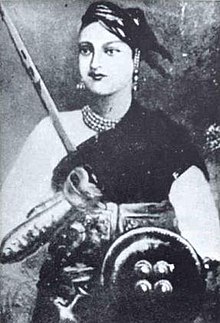
Portrait of Lakshmibai, Queen of Jhansi, dressed as a sowar
Maharani of Jhansi
Reign
  • 21 November 1853 – 10 March 1854
  • 4 June 1857 – April 1858
PredecessorGangadhar Rao
Successor(Kingdom abolished)
British Raj
BornManikarnika Tambe
19 November 1828
Benares, Kingdom of Kashi-Benares (present-day Varanasi, Uttar Pradesh, India)
Died18 June 1858 (aged 29)
Kotah-ki-Serai, Gwalior, Gwalior State, British India (present-day Madhya Pradesh, India)
Burial
Phool Bagh, Gwalior, Madhya Pradesh, India
Spouse
Gangadhar Rao Newalkar
(m. 1842; died 1853)
IssueDamodar Rao
Anand Rao (adopted)
DynastyNewalkar (by marriage)
FatherMoropant Tambe
MotherBha


dit

 
A miniature portrait of Rani Lakshmibai

Rani Lakshmibai was born on 19 November 1828[4][5][6] in the town of Varanasi into a Marathi Karhade Brahmin family.[7] She was named Manikarnika Tambe and was nicknamed Manu.[8] Her father was Moropant Tambe[9] and her mother Bhagirathi Sapre (Bhagirathi Bai). Her parents came from Maharashtra.[10] Her mother died when she was four years old. Her father worked for Peshwa Baji Rao II of Bithoor district.[11] The Peshwa called her "Chhabili", which means "playful". She was educated at home, able to read and write, and was more independent in her childhood than others of her age; her studies included shooting, horsemanship, fencing[12][13] and mallakhamba with her childhood friends Nana Sahib and Tatya Tope.[14][15][dubious ] Rani Lakshmibai contrasted many of the patriarchal cultural expectations for women in India's society at this time.[16]

Rani Lakshmibai was accustomed to riding on horseback accompanied by a small escort between the palace and the temple although sometimes she was carried by palanquin.[17]

Sardar vallabhai patel

Sardar vallabhai patel

Vallabhbhai Jhaverbhai Patel[1][2] (31 October 1875 – 15 December 1950), popularly known as Sardar Patel, was an Indian politician. He served as the first Deputy Prime Minister of India. He was an Indian barrister, a senior leader of the Indian National Congress and a founding father of the Republic of India who played a leading role in the country's struggle for independence and guided its integration into a united, independent nation.[3] In India and elsewhere, he was often called Sardar, meaning "chief" in Hindi, Urdu, and Persian. He acted as Home Minister during the political integration of India and the Indo-Pakistani War of 1947.[4]


Vallabhbhai Patel
Sardar patel (cropped).jpg
1st Deputy Prime Minister of India
In office
15 August 1947 – 15 December 1950
MonarchGeorge VI
PresidentRajendra Prasad
Governor GeneralLouis Mountbatten
C. Rajagopalachari
Preceded byPosition established
Minister of Home Affairs
In office
15 August 1947 – 15 December 1950
Prime MinisterJawaharlal Nehru
Preceded byPosition established
Succeeded byC. Rajagopalachari
1st Commander-in-chief of the Indian Armed Forces
In office
15 August 1947 – 15 December 1950
MonarchGeorge VI
Governor GeneralLouis Mountbatten
C. Rajagopalachari
Prime MinisterJawaharlal Nehru
Preceded byPosition established
Succeeded byPosition abolished (merged to the President of India)
Personal details
Born
Vallabhbhai Jhaverbhai Patel

31 October 1875
Nadiad, Bombay Presidency, British India (present-day Gujarat, India)
Died15 December 1950 (aged 75)
Bombay, Bombay State, India (present-day Mumbai, Maharashtra)
Cause of deathHeart attack
Political partyIndian National Congress
Spouse(s)Jhaverben Patel (1876 - 11 January 1909)
ChildrenManiben Patel
Dahyabhai Patel
MotherLaad Bai (1847-1932)
FatherJhaverbhai Patel (1829-1923)
Alma materMiddle Temple
Profession
AwardsBharat Ratna (1991) (posthumously)

Patel was born in Nadiad and raised in the countryside of the state of Gujarat.[5] He was a successful lawyer. He subsequently organised peasants from Kheda, Borsad, and Bardoli in Gujarat in non-violent civil disobedience against the British Raj, becoming one of the most influential leaders in Gujarat. He was appointed as the 49th President of Indian National Congress, organising the party for elections in 1934 and 1937 while promoting the Quit